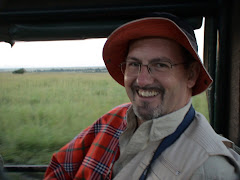
The flight from Wilson Airport to the Okiombo (O-key-ohm-bow) airstrip is only 35 minutes yet the change in settings can be extraordinary. Wilson is the smaller of Nairobi's two airports and sits quite close to the city center. One fights the morning traffic and congestion to make it to the plane. Okiombo airstrip, on the other hand, sits within the the Masai Mara National Reserve. It's just a small maram, a clay and pebble mixture, strip in the open savanna. I was met at that airport by Dee, a Maasai moran, who is one of the drivers and guides for my Tipilikwana Mara Camp where I am staying. The camp actually sits just across the Talek River which is one of the reserves official boundaries. However, animals don't respect boundaries, so sighting are possible from the camp. The drive is only about 10-12 miles, but can take 30-40 minutes.
Nature made itself known within minutes of pulling away from the airstrip. We encountered a small herd of Thomson Gazelle. A large warthog rans across the road not more than 50 yards ahead of the Range Rover. However, not too far in the distance we saw a small group of vehicles stopped. This was the tell tale sign that something good was up ahead.
As we drew near, I saw that it was a mother cheetah with her three cubs trailing her. The mother had a baby Thomson gazelle dangling from her mouth much like a mother cat would be carrying a kitten. I assumed that the gazelle had met already its end. She laid down in the grass and the cubs came up rumbling and tumbling around her.
Dee said that they had watched the gazelle be born the day before I arrived. He knew this was the same one as it was in the same spot and the mother could not have moved far with such a young baby. The cheetah cubs were still covered with a downy coat across their backs. They are about two months old and won't lose that fur for another month or two.
As we were about to pull away, the gazelle started running away, if you can actually call it running. The cheetah cubs then chased after it and one of them caught it and brought it back to the mother. Dee explained that the mother had only injured the gazelle and released it on purpose. It's one of the ways that the youngsters are taught to hunt.
We moved on to the camp but not before seeing animals such as topi, wildebeest, and elands. These are all within the antelope like family. We also saw an ostrich, numerous zebras, and hundreds of Thomson gazelles.
The camp proved to be beautiful and welcoming. Certainly a wonderful way to spend a few days. It's actually the next morning after my arrival and I've been out on two game rides. I've got great stories to tell once I find the time to get them typed up. Bear with me as I do this.
 Where do I begin in regards to the very surreal visit that I paid to Obama's paternal grandmother, Mama Sarah? I guess I should start at the beginning so that I can bore you with some of the minute details. Nah, I won't bore you but I will start with some minute details. [As an aside, if you have Google Earth, you can type in any of these locations and they will show up. In fact, when I put in Bondo, I can actually zoom in and see the hotel that I stayed in. Not all areas have enough resolution for zooming, but the town itself does.]
When I was in Kenya the last time I had done a training in Kasarani near Nairobi. It was for a group of workers from the Ruaraka EPZ. EPZ's are Export Processing Zones. They are tax protected areas where industries can manufacture products quite cheaply. It's where some of the clothing for Walmart, Target, etc. come from. Working conditions are typically very poor. Here is a link to a slide show on the Ruaraka EPZ http://www.slideshare.net/davelettinga/the-lives-of-ruaraka-workers.
One of the attendees was a young man named Kevin. His home is in Bondo which is only about 10-15 miles from the home of Mama Sarah. He is back in Bondo and had invited me down to meet an HIV+ support group to do my "meet and greet." That's not a real good name for what I do, but it's not really a training either. It's more of an opportunity for me to meet a group of people either infected or affected by HIV and hold a simple discussion. The stigma here is still quite strong and so to have a mzungu actually disclose his status is very powerful.
Since I was going to be in the area, I told Kevin that I also wanted to go and visit the birth place of Obama's father. He said that would be easily arranged. I knew that it had become a bit of a tourist stop for the few people that make it to this far corner of Kenya. The area is in the Southwest corner of Kenya and lies about 10 miles inland from Lake Victoria and 20 miles from the Ugandan border. It's people are from the Luo tribe.
One does not go to visit such an important person without taking a present. Okay, maybe one does, but not this one. Even before leaving Bungoma, I talked to my friends to decide what would be an appropriate gift. I had already thought of a chicken and sugar. A chicken because animals are always good gifts and a chicken is easily transported. The sugar because the price of sugar has almost doubled recently. So, after consultations, my list got refined a bit. The sugar definitely remained but some salt was also added. The chicken was good, but I was told that it should be a big hen and should be a white hen.
I wish I could have been a bird and flown to Bondo. It is only about 50 miles as the crow flies, but at least 110 as the matatu drives. It's probably a little longer since the road is so curvy, but that's my best estimate. One travels south to Mumias, east to Kakamega, south to Kisumu and then back west to Bondo. It also means that one changes matatus a couple of times. But, none the less, I made it to Bondo in about 6 hours. Yep, that's right... 110 miles in 6 hours. I had to change matatus 3 times which means waiting between each change for the matatu to fill up. To be fair, I spent an hour in Kisumu eating, so really it was only 5 hours.
My afternoon in Bondo meant doing a little tour and also looking for a chicken. I went to meet Kevin's family who live about 4 miles into the interior. The interior means anyplace that is not really a town. I met his mother and 4 brothers, his grandfather, some uncles, a grandmother, aunts, etc. It was a big deal to have an mzungu visit them. This is something that I've never been totally comfortable with in the sense that I'm afforded a level of distinction that is not necessarily "earned."
Kevin's grandmother had a number of chickens that she was willing to sell. However, it was decided that I should not present a hen, but that it should be a rooster. So, they pointed out one of the white roosters to me and we then agreed on a price. As the rooster strutted around the yard, it appeared really huge. I was to decide the next morning that it wasn't quite so big and scary.
I woke up Wednesday morning and had breakfast and was ready to go by 8:30. Kevin's brother had caught a ride into town with the rooster in a basket. I had the sugar and salt and was ready to go. We had already arranged for a piki-piki (motorcycle) to transport us to the homestead. it's roughly 10-15 miles by dirt road to Mama Sarah's homestead.
We arrived at the gate of the compound. Because of the popularity, a Kenyan Police officer is on duty and you must present ID and sign in to the "official" visitor's book. We were a bit early since, unbeknown to us, she does not receive visitors until 10AM. We went to the sitting area under the tree where chairs are set out for visitors. The compound is certainly well kept. Her house is a permanent structure, meaning brick covered with cement. There were a number of outbuildings. It was a beehive of activity with a woman milking a cow, some sweeping the yard, etc.
At about 10, a woman came out and introduced herself as the interpreter for Mama Sarah. Mama Sarah knows very little English and prefers to speak in her native tongue of Dholuo. Kevin had at least taught me how to say hello and how are you in Dholuo. When Mama Sarah came out and I greeted her in her tongue, she chuckled, greeted me back and then commented to the interpreter that she was surprised.
There was not a lot to ask or say to Mama Sarah. Basically, I made the simple comments about how proud she must be of her grandson. I explained what I was doing in Kenya. I asked about the two quite prominent graves near the sitting area. One, which was made of white porcelain tile is Barack Sr. and the second one is the grandfather.
It was then time to present the gifts. As luck would have it, as soon as I went to hand the rooster to Mama Sarah, it pooped in my hand. Although not pleasant to discuss, I was at least grateful to find out that a rooster's poop is firm rather than watery so I just let it drop onto the ground. I found out that she spoke to her assistant about how nice and larger the rooster was and that they had recently lost many chickens to illness and so it was a great gift. A group of nine Kenyan men had arrived at the compound to visit so I said my good byes and headed off.
It's amazing to think that one can just arrive at the compound and meet with Mama Sarah. As I said, the area is fairly remote. The nearest city is Kisumu and even it does not see a huge number of foreign visitors. Those traveling to Kisumu are usually their to do work for some organization. However, 3 days prior to my visit a group of 8 people from Portland had visited. One signed as an RN, so I'm guessing that maybe they were a medical team. I also saw signatures from a group of Japanese, someone from the Netherlands, and someone from Moscow.
All in all, it was so surreal and will be a great memory to maintain.
 This photo is probably one of my favorite photos ever taken since I began traveling to Kenya. It was taken at a celebration at a training school where we donated an embroidery machine to the sewing class. These two young men played in the local band which consisted of a traditional one-string banjo like instrument, drums made from various sizes of plastic drums, and a hand held 6 or 8 string "harp." I think that I like it so much because it shows the true warmth and camaraderie that is often displayed among people. This lead me to decide to write about how one comes to be this close and affectionate.
Many tourists coming to Kenya are taught that to say hello they simply say "jambo." And the person being greeted will reply back using jambo. To me, I think this is probably similar to putting a t-shirt on that says TOURIST in giant letters. Greetings in Kenya, are extremely important and can be much more complex than simply saying jambo.
The true form of the greeting would be to say "Hujambo" or "Hamjambo" if talking to a group. It literally means "Is nothing the matter with you?" In other words, asking the question in the negative. The proper response would be "Sijambo" or "Hatujambo" if a group. Or, in translation "Nothing." Although this is an acceptable greeting, people often will ask more detailed questions that are meant to be a bit more familiar.
So, for me, I tend to use the term "Habari ya..." This means "What is the news of..." Common things would be Habari ya asubhi or What is the news of the morning? The ending word can be nyumbani (home), watoto (children) or kazi (work). The response given to this question is technically "Nzuri" or "Nzuri sana" which means good or very good. Like in the US, even if you aren't doing well, you tend to say Nzuri none the less. Now, I said that technically, it's nzuri. You'll very seldom hear the N because everyone uses an M, making it mzuri. Don't ask me why this is so, it just is. Other responses that basically mean the same thing would be "Poa" or "Njema" or "Salama."
Now, on to handshakes. These are probably one of the most important aspects of a proper Kenyan greeting. Failure to shake hands could be interpreted as a great sign of disrespect. The only exception that I can think of would possibly be shaking the hand of a Muslim woman as that can be disrespectful in their culture. This part of Kenya is predominantly Christian, but there is still a fair sized Muslim population. So, if I am making introductions, I will wait to see if the woman extends her hand before I do. If it has been a long time since you last saw the person, you may shake hands for an extended period of time as you put your faces cheek to cheek on each side.
A note on greeting people who you need to show respect because of age, title, or something else. Addressing a respected male as Bwana or Baba would be normal and a female would be addressed as Mama. Now, I know in the US calling someone Mama could get you a strange look at the least, here it is respectful. The other thing that you do as you shake hands is take your left hand and cross it over and place it lightly somewhere above the elbow of your right arm as you are shaking.
Okay, you've come to visit Kenya and you've got the greetings all down pat. You may think you're ready to go about your visit, but you need to know a few more things so as not to offend someone or get surprised by what they might do with you. Showing affection in public is something that members of the opposite sex very seldom do. This is changing somewhat in the larger cities, but it is extremely rare to see a couple or husband and wife walking down the street hand in hand. It's just not done.
Now, seeing members of the same sex showing affection is a completely different story. I think maybe that's why I like the picture I've posted so much. It shows the ease with which friends show warmth to each other. It's take me some time to get used to a male friend grabbing my hand and walking down the street together kind of swinging or hands together in step with our walk. Or, we may sit together and he will put his arm around me as he talks to me and asks of the news. This would be common among two female friends as well.
I remember on my first trip when I was saying my goodbyes to one of the class organizers that I had worked with for about 6 weeks. He grabbed me by the hand and walked me over into a corner of the church yard where we were. He proceed to tell me how grateful he was that I was there, wishing me a safe journey, etc. The entire time he was doing this he was continuing to hold my hand while he softly stroked my forearm with his other hand. It was such a new and strange feeling . Doing that in public in some parts of the US could lead to getting the crap beat out of you.
So, how do I wrap up this little blog entry. I guess I wrap it up by saying that I have a copy of that photo on my bulletin board just above the desk where I am sitting. It's one of several pictures that I have posted there as a reminder of some of the simple things that make me happy here. That one in particular shows me that it is a wonderful thing to be able to show affection to a friend in a sweet yet simple way.
Okay, some of you that follow me on Facebook may know that I've become somewhat (okay, maybe very) addicted to the virtual growing of vegetables and livestock on Farmville. Let's just say it's one of my guilty little pleasures to take my mind away to more mundane things in life. I've currently got a nice selection of produce ripening in my lush fields. The joys of virtual farming include the guarantee of lush, bountiful harvests as long as you click your mouse within the prescribed length of time allowed within the program's algorithms. If you don't, then your crops wither and die.
If only things in Kenya were as simple as a click of the mouse. Farming here is quite labor intensive. Most people still farm by hand, quite like I do with my little hoe on Farmville. The big difference being that it takes muscles and energy here in Kenya and a push of my index finger on Farmville. I never have to worry about whether my crops will suffer from a drought the way much of Kenya is currently suffering. I don't have to worry about getting my livestock to market through lands that are void of water. It all just magically happens for me.
Food prices have been increasing steadily over the last couple years. Prices first rose after the post-election violence and have continued to increase during the current drought. It's estimated that by the end of the year, up to 10 million, or one third of the population may need food aid. There is not a day that goes by in which there is not at least one article in the paper about the crisis.
So, what does the average Kenyan eat on a daily basis? It's a diet that is heavy on starch. There's a lot of corn (maize), cornmeal, rice, potatoes and beans consumed. Certainly, there are vegetables available. Meat, poultry and seafood are available at varying degrees based on location and income. For me, one of the wonderful things of being in Kenya is the availability of good fruit. So, let me decide where to start with the descriptions.
I would have to say that ugali is probably the main staple of the Kenyan diet. It is basically Kenya's version of our grits, Italy's polenta, or Zimbabwe's sadza. It is corn meal that is cooked with salt and water until it becomes very thick. It's then turned out onto a plate and formed into a round cake-like form. It's then served with the rest of the meal and is used as the base or filler. One breaks off a piece of the ugali, scoops up something else on the plate, and then pop it into the mouth. This is finger food at it's best (or worst, depending on your tastes). Personally, I enjoy ugali but it's an acquired taste since it is pretty bland. Many people will not feel that a meal is complete unless they have had some ugali.
Apparently, one can get an idea of what part of the country you are from based on how you treat your ugali. I was having lunch at a traditional Kenyan restaurant in Nairobi with a group of friends. Within the group we had some Bukusu, Kikuyu, Luhya and Luo. These are all different tribes of Kenya. One of the people started laughing and comment that I was becoming a Luhya. Apparently, Luhya's will tend to break off their piece of ugali, roll it into a ball, and then put a small indent into one side before scooping up the other food. This to me was just natural since I had learned to eat my ugali by parroting the people I was around.
Rice is another popular dish. It's eaten in place of ugali. Sometimes, a family will make crazy rice. This is simply rice with whatever vegetables are available and maybe some small amount of meat. Often, masala spices are added. This shows the influence of the Asians. Note, that Asians in Kenya are who we, in America, would call Indians. The Asians were brought into the country years ago by the British colonizers to be used to build the railroad. They've become an important part of the economy here and are often the business owners.
Beans, beans, the magical fruit, the more you eat, the more you.... well, maybe some of you know the rest of that little childhood song. Beans are probably second to ugali in being a staple. The most common bean is basically a red bean that is sometimes cooked alone and sometimes cooked with maize. When they are cooked with maize, it's called githeri. Githeri began as a staple dish among the Kikuyu but has become a staple dish across many tribes. Other beans are green grams (lentils) and cow peas. They're a good source of protein in the Kenyan diet.
Sukuma wiki is the number one vegetable eaten here. It's our word for kale. It's very finely shredded, what a chef would call a chiffonade. It's sauteed with oil and maybe some chopped onion of tomato when available. It would not be uncommon for a family to eat just some ugali and sukuma wiki and call the meal complete. I end up bastardizing mine by added chili sauce. Face it, I eat my southern greens in the US with hot sauce so why not do the same here?
Other common vegetables eaten and grown are carrots, potatoes, onions, tomatoes, and cabbage. It's not a huge variety, but it does the job. Certainly, the Nairobi grocery stores carry a much larger selection of imported vegetables. However, even within Nairobi, most of these vegetables are out of the price range of the average Kenyan. The grocery stores of the city are meant to be used by the expatriates and the upper class Kenyans. There is a small middle class that would shop there as well.
Fruits, now they can be heaven. Pineapples, mangoes, oranges, bananas, papaya and watermelon are all readily available. A smaller size pineapple costs me about $1.20 and is so sweet and juicy. I know I will upset one Hawaiian reader, but they beat the freshest pineapple from our 50th State. Most of the bananas are what I will call finger size bananas. They are small and very sweet. I'd like to ask Sunkist what they do to make their oranges so orange. A ripe orange here is still more green than orange, but sweet none the less.
Meat and poultry is consumed but not on a routine basis. It is simply too expensive for the average family. Lake Victoria tilapia is also easily purchased. I can buy a quarter kilo (half pound) of meat with no bones for $1. Even I don't buy it too often. Chicken tends to be quite tough and something I only get occasionally in a restaurant. I just don't know how to pluck and gut a proper chicken, nor do I want to know. And, without a refrigerator, I couldn't store the left overs. People also consume goats here. Eggs are freshly laid and bought by the piece. One egg costs me 8 kenyan shillings or about 11 cents.
So, there you have it. The basic foods of the Kenyan diet. I end up sticking to a similar diet as the native Kenyan but have to supplement a little bit. I sometimes feel that I struggle to get enough protein. With my HIV medication, I have to worry about my cholesterol. As much as I know I can get protein from the eggs, I limit the amount I eat. Breakfast is often the childhood standby of peanut butter and jam on bread.
 The old saying, "Be careful what you wish for," was all too true for me this morning. On my Facebook status, I posted "John Motter needs a another cup of coffee and then needs to write a new blog entry. Trying to decide what the topic should be. What do y'all want to hear about.?
A few minutes later, Paul responded by saying "Usually, the more mundane, the more interesting. Grocery shopping. Local news. Last evening's social interaction. It's all interesting from this far-away vantage point."
Then, I got an IM from my friend Russell who is now living in Vermont. He wanted to call me, but not knowing I was in Kenya, he had to give me the sad news via the internet. A friend of mine from my Seattle days died several weeks ago. His name was Glen McGear and he would have turned 46 on October 10th. After some tears, some typing, and some more tears, Russell and I said our goodbyes. I don't have a lot of information on the final cause of death for Glen, but am sure that it was of complications from HIV/AIDS.
You might wonder why I mention Paul saying to write about the mundane. It's certainly not because Glenn's life was mundane as it was far from that. It's not that his death is coming from a far-away vantage point. After all, Glenn was living in Seattle at the time of his death. I guess it's because deaths from HIV/AIDS continue to be all too common, all to "normal." Does anyone still become shocked by them? We should, but instead, I think we tend to mourn the death of that person and think it's just the cycle of life. And, maybe, just maybe, it is.
Everyone put on this earth will live and then will die. Some people die as babies from malnutrition, malaria, or dysentery. That's certainly a common happening here in Kenya as well as many other parts of the world. Some individuals are taken later in their childhood or youth from childhood forms of cancer, child abuse, or vehicular accidents. Some of us make it into our 30s or 40s, and then others live to a "very ripe old age." My one great grandmother made it to 103. Trust me, I'm glad I have some of her genes.
The issue for me this morning, is how do we put the memory of a person into perspective in such a way that we honor them. With Glen, I have some very fond memories of laughter and camaraderie. I have some memories of arguments as we both had strong personalities. But, I think what I will remember going forward is the activist spirit that he delivered as a result of living with HIV. He wanted to use his experience as a way to improve life for others. I don't think he did this for a pat on the back. He did it because, deep down, he was a very special person.
I first met Glen shortly after I moved to Seattle in January of 1996. Of course, I was still drinking then and we met while I was having cocktails in a local bar. Glen was a big person in many ways. First, he was tall, probably about 6'6" with an outgoing personality to match. He was already on disability by then. We hit it off and remained friends during my time in Seattle.
I have to say that as I hit my bottom, I let some of my friends slip to the side. Glen was one of those people. Yes, we still saw each other occasionally, but I was to wrapped up in the drama of my life. It was several years later that we were able to reconnect.
I was already involved as one of the Oregon spokespersons for HIV Stops With Me. The Seattle campaign recruited Glen to be on their campaign. We were able to joke about him being the "black" slot and I was the "former alcoholic/addict" slot. We made a great pair. Being on that campaign meant that our faces were on the internet, on bill boards, and TV ads (for Glen). We put ourselves out in the community as the "Faces of HIV." It wasn't always a popular stance. Sometimes I said things publicly or in print that got the ire of some in my community. Glen did the same thing. You see, the campaign was not about the right or wrong way to behave. It was about sharing how we behaved and what our thoughts were on that behavior.
Glen was featured in the client spotlight for Lifelong AIDS Alliance in Seattle. You can read his blurb at http://www.llaa.org/glen. He volunteered at Bailey-Boushay House. This organization served as both a residential care center and a day center for people living with HIV. Glen did a lot of other things that no one will ever know about. As Russell said to me this morning, "Glen was my sounding board."
Glen struggled in the last couple of years. He had serious bone necrosis (death) as a result of being on his medications for so long. He was having heart issues. Yes, he did complain at times. Yes, he did get depressed at times. But, he kept on fighting and struggling.
I have lost so, so many friends from this disease. It's never easy to hear the news. It always makes you look at your stage of the illness and wonder what is in the future. But today, I'm trying to look at the dignity with which Glen lived his life. He never made apologies for his illness. I'll truly miss him.
 It's been nearly a year since my trip to Zimbabwe, but it has been on my mind quite a bit lately. This is partly due to the emails I've been reading about Veronica's son, Kudzai, traveling to Portland to attend school. It's also due to the emails about the painting over of a beautiful mural depicting the community of St. Werburgh's in Chigadora Zimunya outside of Mutare. Regardless of the impetus behind Zimbabwe being towards the forefront of my mind, I felt a need to followup with Veronica.
Veronica Nyoni is the remarkable woman responsible for getting the Mutare side of the Portland-Mutare Sister City relationship. She is Head Mistress at the school and overseas pretty much all of the other activities in one form or another. She has the help of a wonderful husband and family and a strong community. I can't say enough about her strength and faith in an environment that is not always welcoming to hope.
The picture shown here was taken on the day our delegation visit the school and clinic last October. The two young girls in the picture are Tania, age 11, and Kudakwashe, age 13. They are both living with HIV. At the time of our visit, Kuda was quite ill and I really didn't expect her to live much longer. Her belly was so swollen which I was told was a result of her system shutting down. However, this morning I had an email from Veronicah giving me the news that both girls are still living and continuing with hope and faith.
The photograph is just one of a series of photos taken as I talked to these young girls. I was down on my knees so that we could see each other eye to eye. I didn't want to be the imposing adult, making them look up to me. I wanted to be as close to their equal as possible. It was a hard time emotionally. I can remember telling them to remain strong and keep their hope alive. I didn't make the promise that things would be better as I didn't want a promise to be broken. However, I knew there can always be hope.
Their lives are not easy. Tania was already living in a child headed household having lost both of her parents. She had bounced around a bit among relatives and eventually came to be in the St. Werburgh community where teachers can help to oversee the family. Currently, she is suffering from a serious skin rash.
Kuda has had a very difficult year. She had already lost both of her parents and was living with her grandmother. As is often the case, the grandmother had become the primary caregiver to Kuda and her two brothers and her older sister. But, unfortunately, the grandmother died leaving them as a child headed household. Kuda went terribly sick after the death of her grandmother.
Being a child headed family challenges the taking of her medication. The sister and clinic staff have come up with a method of making sure the medicines are taken at school. The teachers have also been trained to counsel and are giving additional psycho-social support. They've even begun school based support groups.
What is the demand for such support groups? The school currently has 984 students enrolled. Roughly 44% have lost at least one of their parents. This means that, for many, the remaining parent is also living with HIV/AIDS. It also means that many of the students are HIV infected. From May to the 2nd of August, 3 children died and 7 remain gravely ill.
It's a constant struggle and an uphill battle. However, the people of this community have an enduring faith that times will improve. The struggle will make them stronger. It is a faith that I continue to be in awe of as I struggle through my own daily life. It provides me with a nourishment of strength that I sometime forget that I possess. I'm blessed to have experienced their warmth and comfort.
After being up for several hours this morning, I laid down to take a short nap. Upon awakening, I listened to the sound drifting in through my open window. I realized how at times it comes through as a wonderful melody while other times it is harsh on the ears. I decided that after several pretty sobering entries, today was the day for a little more lighthearted discussion of small town life in Bungoma.Initially, I wanted to discuss the "cacophony" of noise. However, I thought I'd better clarify the meaning of the word in order to insure that I would be using it correctly. So often, as I type away on this blog, I know that I am creating a host of grammatical errors that would make any editor cringe. For whatever reason, correctness was important to me today.The definition of cacophony I finally settled on was the following: harsh, inharmonious collection of sounds; dissonance. As an example, "The beautiful harmony of the symphony was well enjoyed after the cacophony coming from the stage as the orchestra warmed up." This example was perfect as it really exemplifies how I feel at different times. I don't always know when the warm up ends and the symphony begins.I probably live about 200 yards, at most, from the Jamii (Community) Mosque. As such, the first sounds of the morning come through my closed windows at about 5AM. I don't always wake up to it, but even when I do, it usually comes as a reassuring sound to the start of a new day. I don't understand the language of the morning call to prayer, but it serves melodic sound. The imam's voice chants over the loudspeaker throughout the day, but it's that first one that I notice most often.My apartment building is a beehive of activity every morning. It is a 2 story structure with the rooms opening onto a inner courtyard. The upper story has an open area where laundry can be done and hung out to dry. It's also the area for people to wash their dishes if they are in a room that is without it's one bathroom and shower. You see, some people share a communal bath and shower area. This open area becomes a community living room for visiting and gossiping. My bedroom window looks out directly onto this area.By 7AM, two of the young bachelors were busy doing their laundry. They are both matatu conductors responsible for collecting the money and paying for the petrol and the driver as they ply their routes. Since they work 6 days a week, I always know I will find them doing laundry early on Sundays so that they can then head off to church. There is the sound of sloshing water, talking and laughing, and sweeping of water towards the drain.Fast forwards a short while longer and it's the turn of people doing dishes. Are they left over from last night or this morning's sufuria (cooking vessel) used for making chai? Other folks come out brushing their teeth. It's amazing how loud that can sound at times. The small watotos (children) have woken up and are on the first level playing and laughing. Mothers call to them but they must not listen as I here them call once again.Soon, I hear singing and praying coming over the loud speaker from the church a hundred yards behind the building. The Kiswahili is unknown to me for the most part. I know the meaning of Baba and Jehovah but the rest is lost to me. This morning's sermon seems to be a bit more fire and brimstone than what is normal. Or, at least the tenor and intonation implies such.Off in the distance, I can hear the bleating of sheep and goats. They are tied up along the road where they can graze on the meager grass and sift through the garbage that will be collected tomorrow by the City Council wagon that serves as the garbage truck. The cat in heat has returned to the roof above me. I heard the thud of it pouncing above my head at the same time it let out that irritable cry that bothered me so much last night.The clanking of the workers in the mechanic yard behind me has started up again. It is a slow day in the yard. Many of the workers are probably in church, but the few remaining have started to work a little later than is usual.Is all of this, by definition, harsh or inharmonious collection of sounds? Not today. Today it is relaxing and reassuring to my ears. It lets me know that all seems normal in my little building, in my little world. It's been a wonderful welcome to the start of the day. I know that I can add my own sounds of washing dishes and sweeping my floors. It lets me know that I'm at peace.
 The flight from Wilson Airport to the Okiombo (O-key-ohm-bow) airstrip is only 35 minutes yet the change in settings can be extraordinary. Wilson is the smaller of Nairobi's two airports and sits quite close to the city center. One fights the morning traffic and congestion to make it to the plane. Okiombo airstrip, on the other hand, sits within the the Masai Mara National Reserve. It's just a small maram, a clay and pebble mixture, strip in the open savanna.